
Two Landscapes By Hermanus Koekkoek The Younger Go Under The Hammer
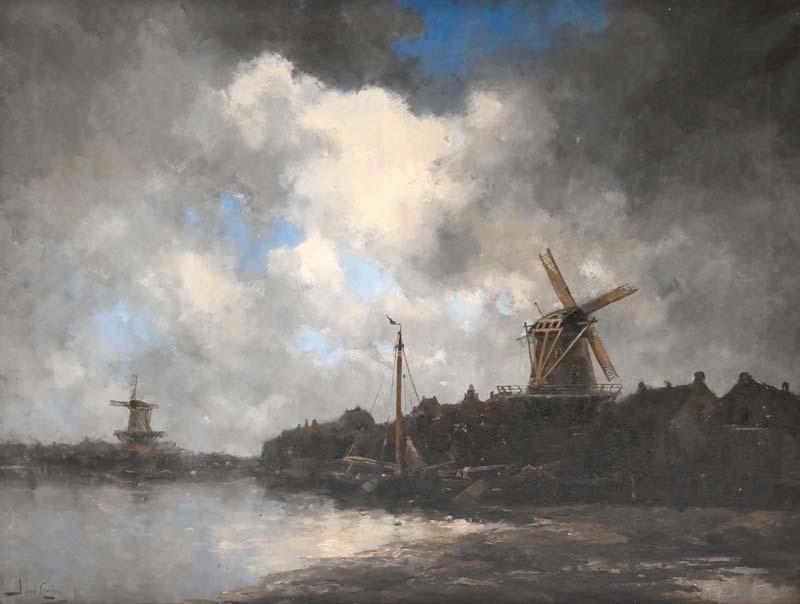
Two dramatic Dutch oil paintings are getting plenty of attention ahead of our January 2024 Antiques and Interiors sale.
They are both signed 'J Van Couver' but our art specialists report that this was an alias used by a London-based painter and art dealer.
So who was the mysterious artist behind this pair of moody waterside scenes?
Who Was Hermanus Koekkoek The Younger?
Hermanus Koekkoek the Younger (1836-1909) was born in Amsterdam into a family of artists.
His grandfather, Johannes Hermanus Koekkoek (1778-1851) was a painter and draftsman. His father was Hermanus Koekkoek the Elder (1815-1882), a painter, etcher and graphic artist who specialised in marine art. His uncle, Barend Cornelis Koekkoek (1803-1862), was a noted landscape painter and lithographer.
The elder Hermanus trained all four of his sons as painters, including his namesake eldest child.
When he was in his late twenties, the younger Hermanus began visiting London before relocating there in 1869. While living in England, Hermanus used the pseudonyms Jan van Couver and Louis Van Staaten.
As well as being a prolific painter, Hermanus opened an art gallery in 1880, specialising in works by his family members, notably his uncle Barend, as well as paintings by Willem de Haas Hemken, Johannes Marius ten Kate and Cornelis Springer.
Hermanus Jr died in 1909 in London and was returned to The Hague for burial.
Impressionist Impasto Landscapes
Hermanus Koekkoek the Younger’s work shows the influence of Realism. Even after his move to London, his subjects were generally masted ships in choppy waters, as well as the canals of the Netherlands with identifiably Dutch elements like windmills often depicted.
From the 1880s, Hermanus’ work shows the influence of the Hague School, also called the Gray School. Hague School artists painted mostly in subdued colours and sought to convey mood and atmosphere, rather than a strictly accurate depiction of a given scene. Dramatic weather was a hallmark of the Hague School.
These works have an appealing impressionistic feel, achieved with confident brush strokes and a thick impasto effect, giving a three dimensional appearance. Hermanus paintings from this period bear comparison to the work of Jacob Maris (1837-1899) who specialised in cloudy landscapes.
Buy Jan Van Couver At Auction
In our first two-day Antiques and Interiors sale we have a pair of oil on canvas paintings by Hermanus Koekkoek the Younger, both signed ‘J. Van Couver’.
Each measures 76.5cm by 115cm (30" x 40") and are framed in gold.
The first piece shows a masted ship moored in front of a windmill. On the far bank of the waterway a church tower and houses can be seen. The moody sky reflects off the shining water.
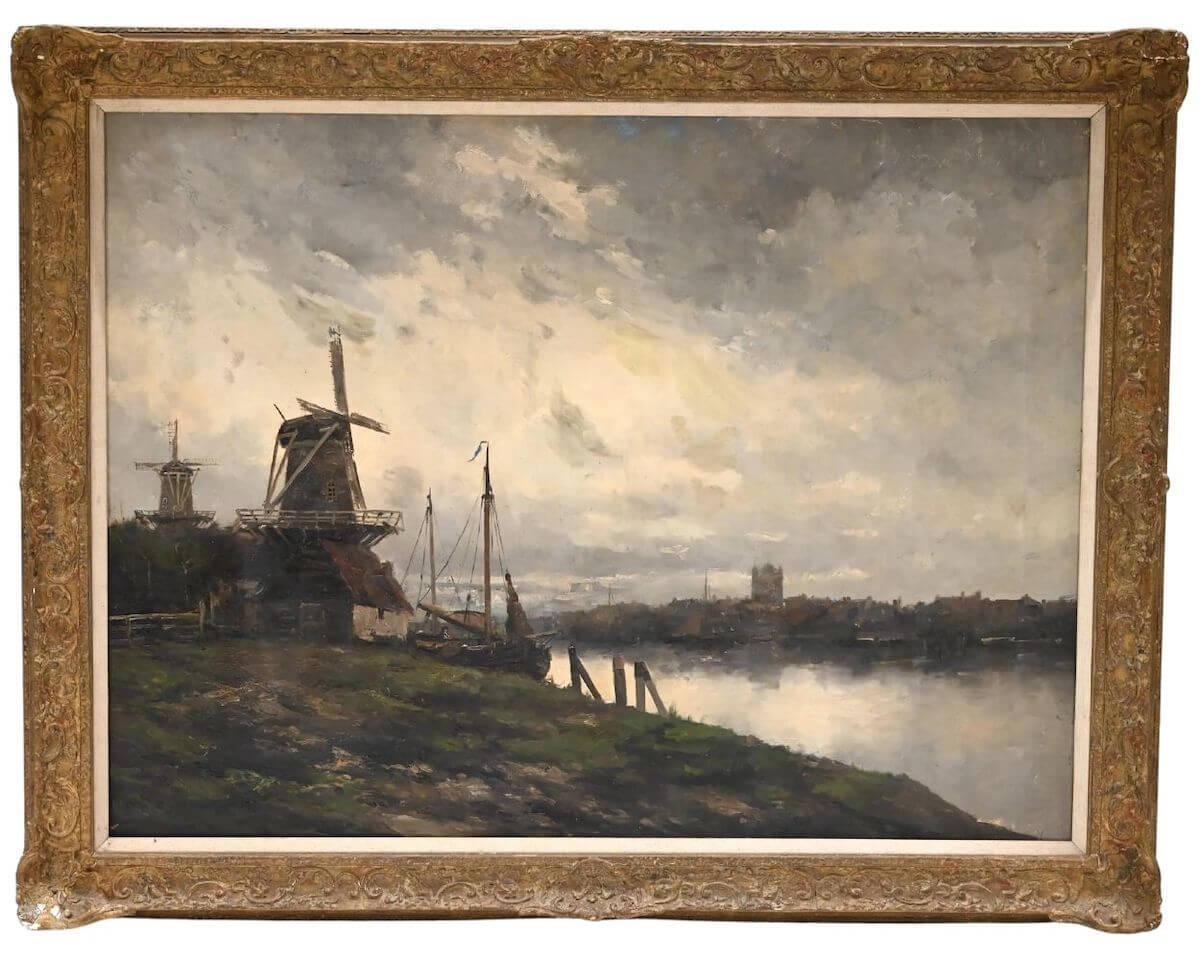
Carved wooden gold frame and signed J Van Couver, this later work by Hermanus Koekkoek the Younger shows a grey sky reflecting on still waters with a windmill in the foreground.
The second painting is dominated by a windmill with a shored boat in front. Patches of rich blue sky peak through the clouds and reflect off the still water of a canal or river whose banks form the foreground of the scene.
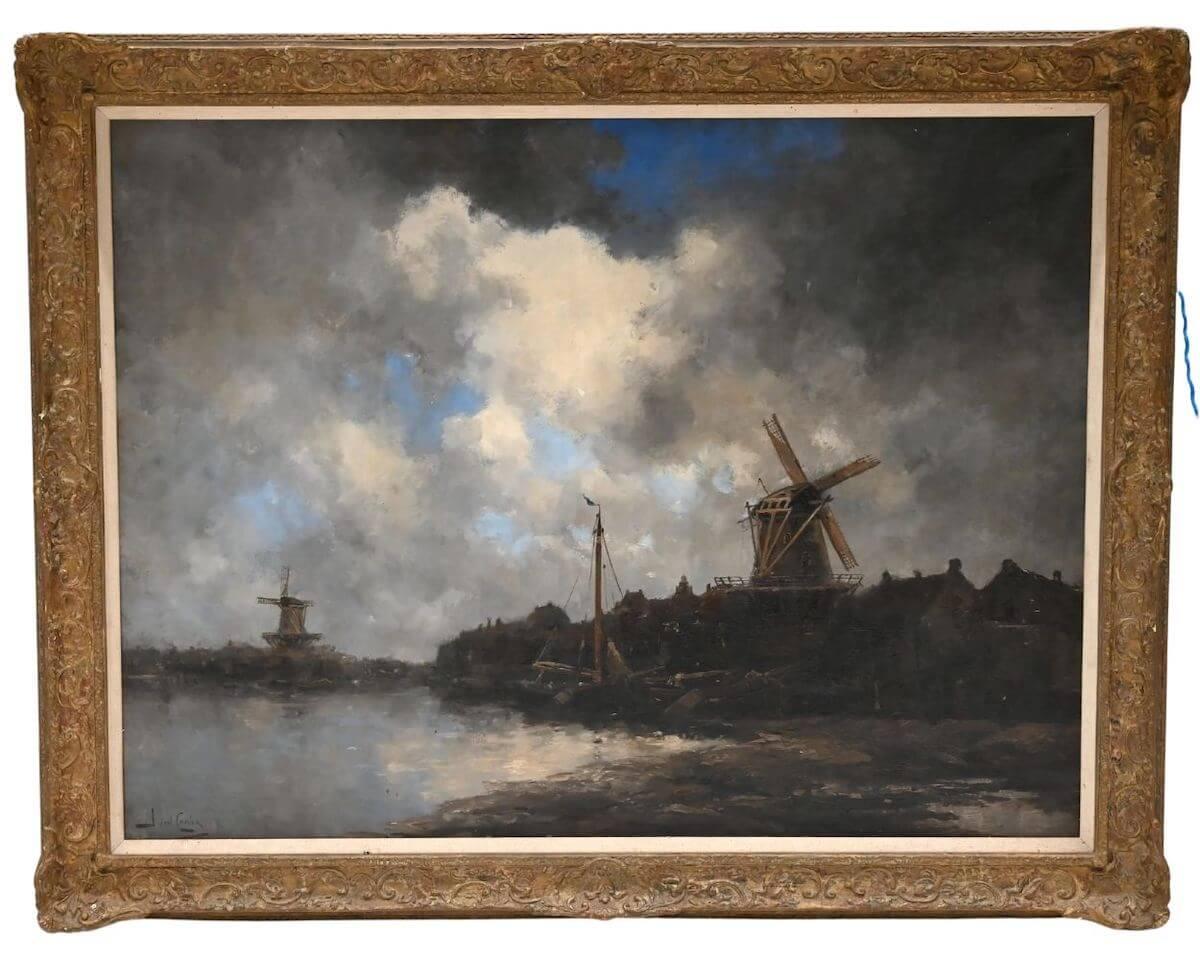
An atmospheric Dutch waterside scene is the subject of this painting by Hermanus Koekkoek the Younger, going under the hammer as part of a pair at RWB Auctions in January 2024.
These works with their fast brushwork and dramatic atmosphere no doubt date from the latter part of Hermanus’ career and were likely painted in London, despite their typically Dutch subject matter.
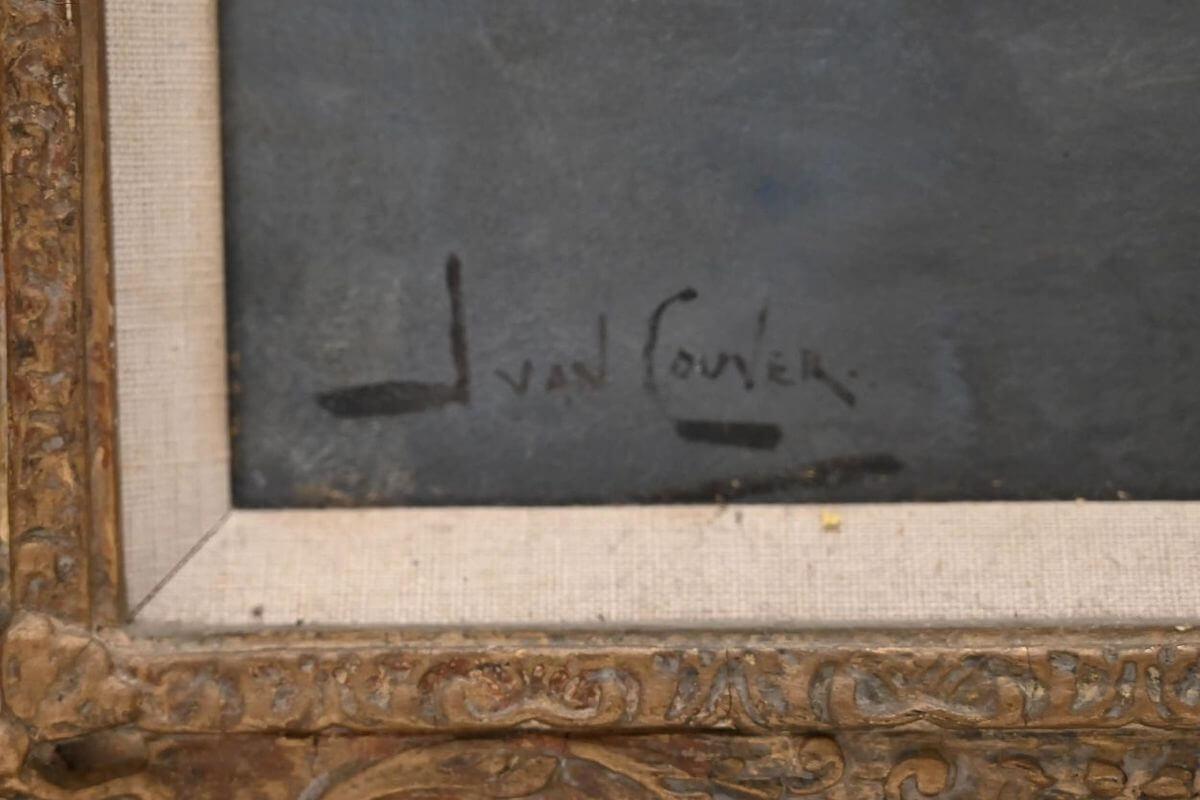
Hermanus Koekkoek The Younger signed some of his work ‘J Van Couver’ including this impressionistic piece likely produced in London in the late nineteenth century.
These two works are being sold together with an estimate of £1,000-£1,200 on Thursday 25 January 2024 along with a diverse range of other paintings, prints, ceramics, glass, furniture, clocks, jewelry and coins. View our Day Two catalogue for more photos and further information.