Newton's Terrestrial Pocket Globe



Newton's Terrestrial Pocket Globe
- Sale Date: 3rd September 2025
- Estimated Price: 3,000.00
- Gavel Price: £3,400.00
Item Description
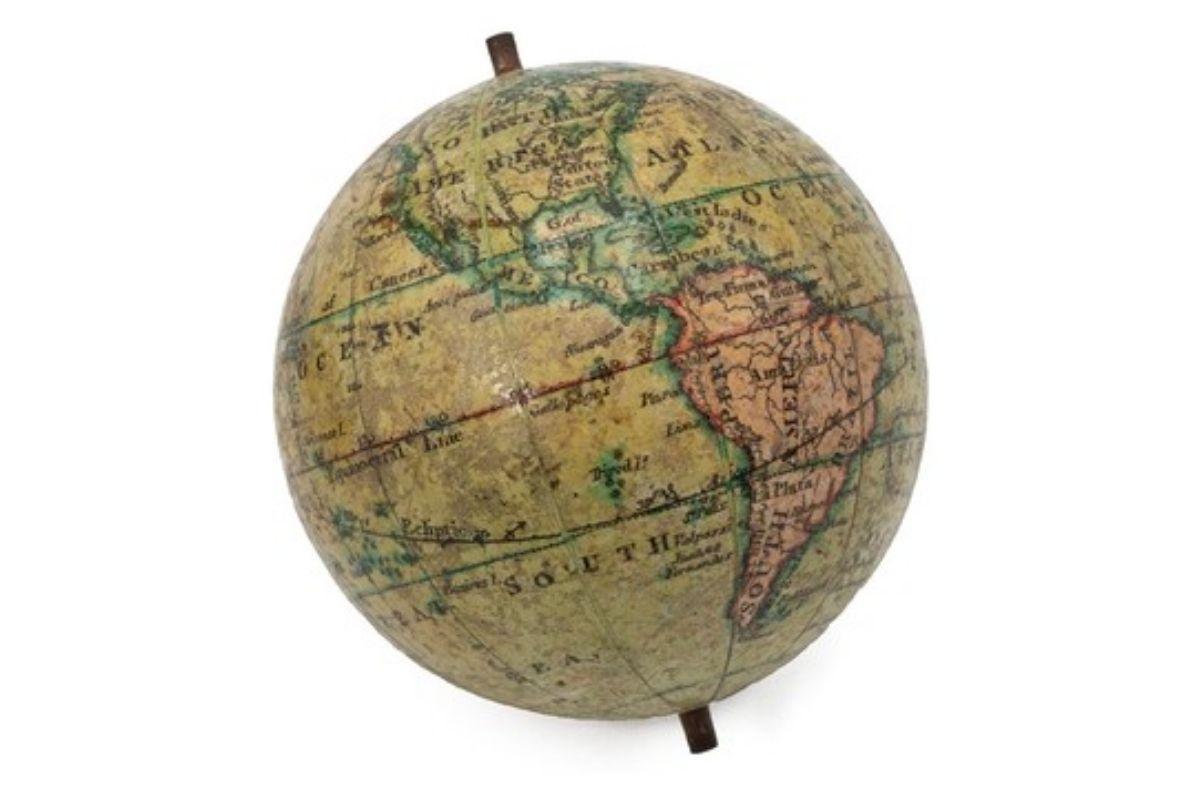
Newton's New Terrestrial Pocket Globe, dated 1818, in original shagreen hinged case with two hook and eye clasps, enclosing celestial segments to the interior, the globe supported by two iron pins within the case. Marked 'Newtons New Terrestrial Globe to the Interior'. Diameter case 5.6cm.
In our 3 September 2025 Antiques & Interiors auction, a beautifully preserved early 19th-century pocket globe achieved an excellent hammer price of £3,400. This sale provides the perfect opportunity to explore the history of pocket globes and what makes them so collectable today.
What Are Pocket Globes?
Pocket globes are miniature representations of the Earth, typically measuring between two and three inches in diameter. Far too small to be used for practical navigation, these globes were instead intended as decorative or educational objects, often displayed on a desk or in a study as a symbol of learning and refinement. Some may also have served as teaching tools for children, offering a compact, tactile way to demonstrate how the Earth spins on its axis.
Many pocket globes come in protective cases, commonly lined with celestial maps or astrological diagrams, giving the owner a view of both the heavens and the Earth. Pocket globes are also found mounted on tiny stands, designed to spin like their larger counterparts
The example sold in our September sale measured approximately two inches in diameter, firmly placing it within the traditional size range. Its case interior depicted the phases of the sun, adding another layer of detail and interest to an already fascinating object.
A Brief History of Pocket Globes
Pocket globes are a distinctly British tradition, with the earliest known examples produced by Joseph Moxon in the 1670s. Moxon, a printer, instrument maker, and Fellow of the Royal Society, pioneered the form as both a luxury item and a conversation piece, allowing the scientifically minded elite to discuss the latest discoveries in coffee houses and meetings of learned societies.
These globes reached the height of their popularity during the late 18th century, a period marked by rapid developments in global exploration, colonial expansion, and scientific enquiry. As cartography improved and European powers vied for influence overseas, pocket globes became fashionable symbols of intellectual curiosity and geopolitical awareness.
Far from being static curiosities, pocket globes reflected the contemporary worldview of their time. They displayed current political boundaries, recent discoveries, and prominent exploratory routes. Each globe, in effect, is a snapshot of how the world was understood in a particular historical moment.
What Makes Pocket Globes Collectable?
Pocket globes are collectable because they combine scientific heritage, craftsmanship, decorative appeal, and historical insight in one compact object. The scarcity of surviving 17th, 18th, and 19th-century examples means pieces that come to auction attract attention from a global audience of serious collectors.
The globe sold in our September auction possessed many of the features that define a highly collectable example.
Firstly, it was in generally good condition, with no major losses or damage to the paper gores. Importantly, the globe retained its original case, covered in shagreen: a textured, durable material made from the skin of sharks or rays. The case's interior included a well-preserved diagram of the phases of the sun, adding both scientific and decorative interest.
The maker also plays a crucial role in a globe's appeal. This example was produced by Newton, a respected London globe-making firm, established in 1783 by John Newton, and operating from various addresses on Chancery Lane. By 1818, when this globe was produced, Newton's was a father-son partnership, trading under the name J & W Newton, and advertising their premium range of pocket globes and larger table globes, examples of which are now held in institutional collections.
What sets any antique globe apart, however, is its ability to represent a fixed moment in geo-history. On this 1818 example, the United States occupies only a modest portion of the eastern seaboard of North America. Australia is still labelled as New Holland, and the globe meticulously charts the route of Captain Cook's third voyage. These details not only reflect the geographical understanding of the period but also reveal the political and exploratory priorities of the time.
Selling Pocket Globes At Auction
If you have an antique pocket globe and are considering selling, contact RWB Auctions for a professional valuation. With specialist knowledge, national exposure, and a strong track record of results, we are well placed to bring your item to the right market. Our low seller's fees mean you keep much more of your profit when compared with traditional auction houses.
Further Reading
Dekker, Elly, and Peter van der Krogt. Globes From The Western World. Philip Wilson Publishers, 1993.
Postrel, Virginia. 'Pocket Globes: The World In Your Hand'. Online Library Of Liberty. 28 April 2022. https://oll.libertyfund.org/publications/reading-room/Postrel_Pocket_Globes.
Taylor, Katie. 'Pocket-sized Globes'. Whipple Museum Of The History Of Science. 2009. https://www.whipplemuseum.cam.ac.uk/explore-whipple-collections/globes/pocket-sized-globes.