South African Gold Mining Brooch
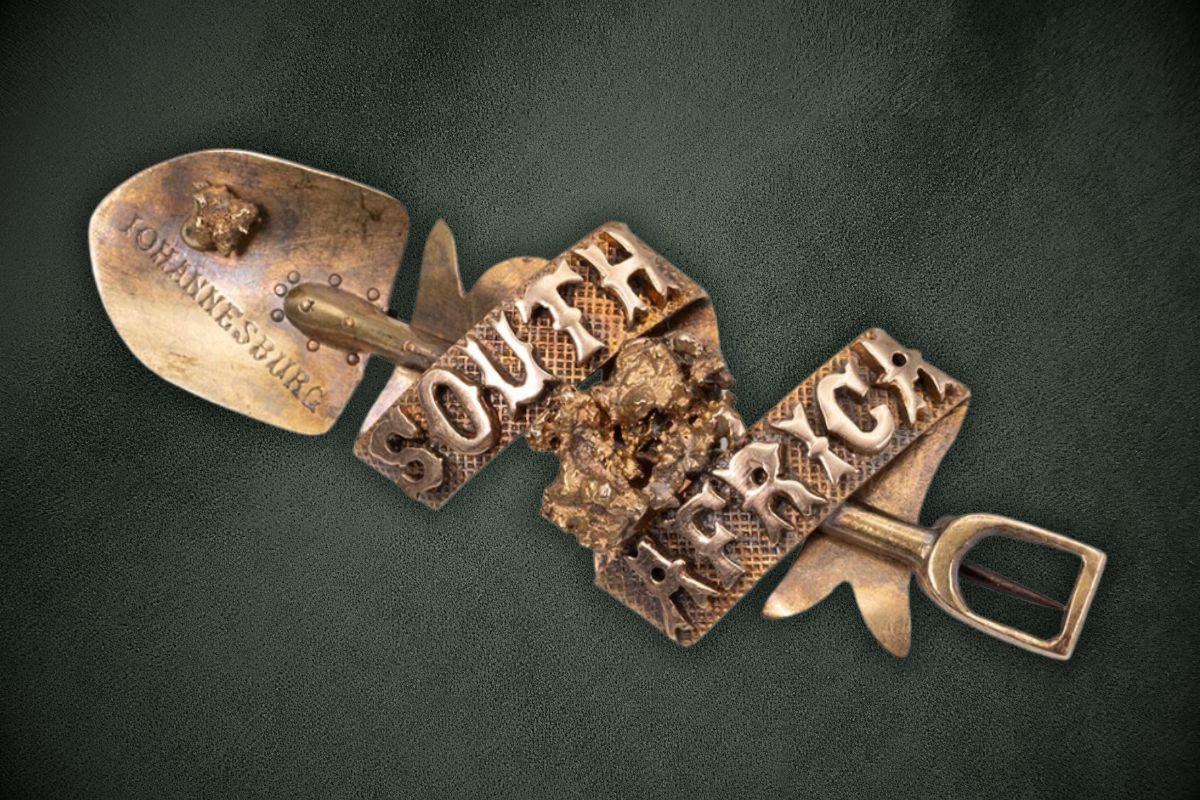
South African Gold Mining Brooch
- Sale Date: 20th August 2025
- Estimated Price: 350.00
- Gavel Price: £420.00
Item Description
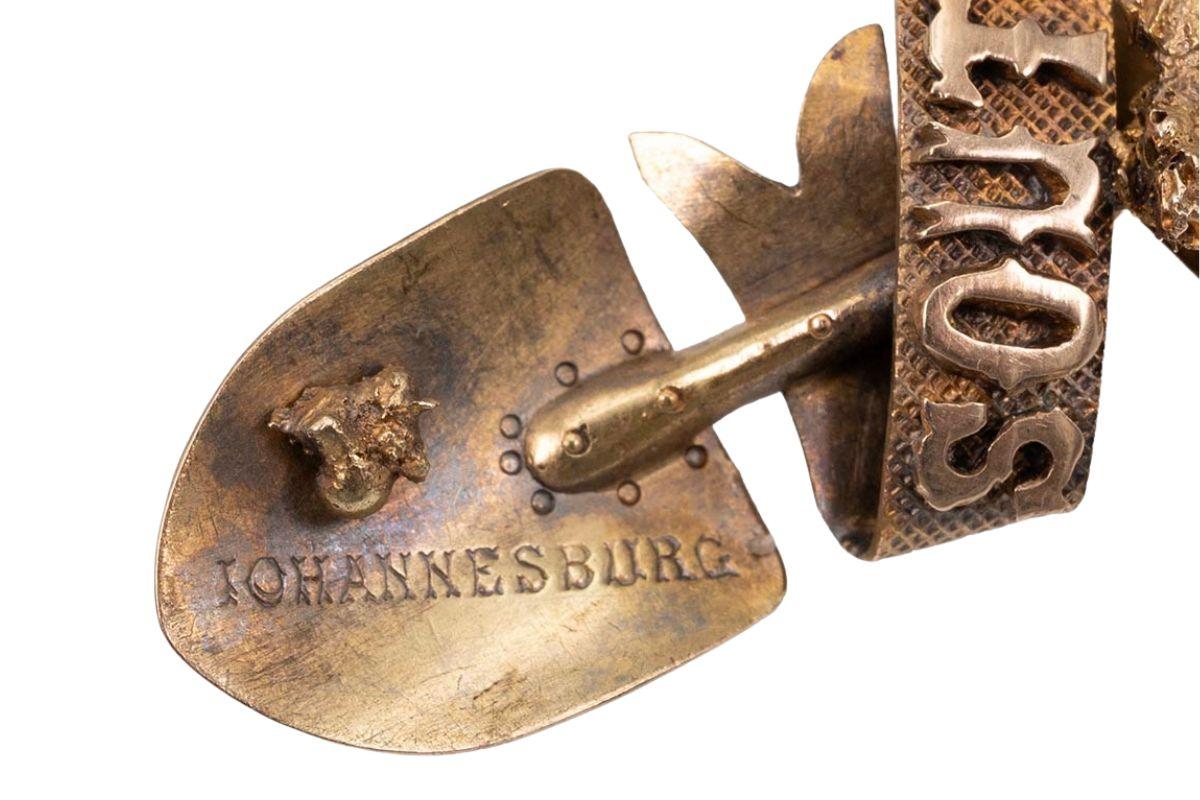
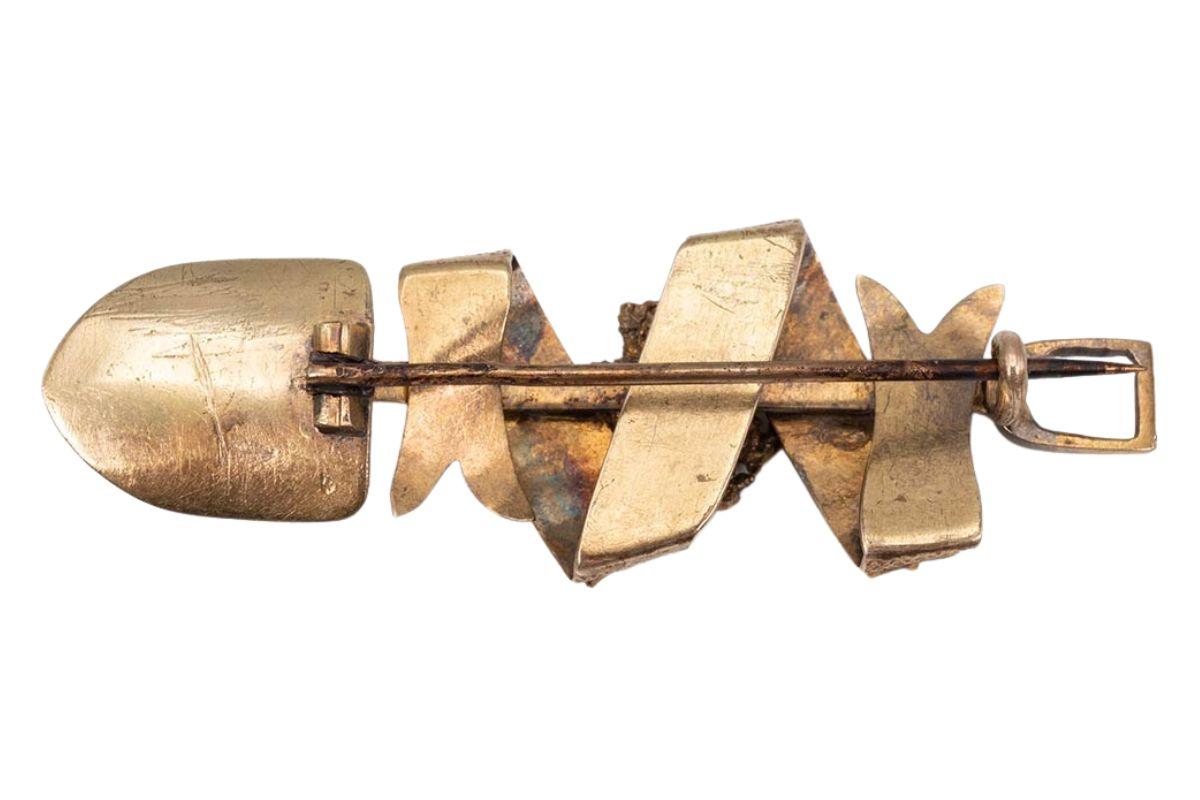
Yellow metal South African goldfields brooch in the form of a shovel stamped ‘JOHANNESBURG’, tests as 18ct. Weight 9.4 grams.
This antique brooch was a staff favourite in our 20-21 August 2025 two-day sale of Jewellery, Silver, Watches & Coins. Designed around a natural gold nugget, it is an appealing example of a goldfields brooch: a category of jewellery with a fascinating history and a passionate collector following.
What Is Goldfields Jewellery?
Goldfields jewellery is a direct product of the great gold rushes of the 19th century, which transformed the economies and landscapes of Australia, South Africa, the United States, Canada, New Zealand, and beyond. Wherever gold was discovered in quantity, mining settlements sprang up almost overnight, and skilled jewellers (many of them immigrants who had followed the rushes in search of their own fortunes) set up workshops to serve the newly wealthy communities around them.
Australia was the birthplace of goldfields jewellery. Gold was discovered in the British colonies of Victoria and New South Wales in the 1850s, drawing would-be miners to rapidly expanding boom towns. A distinctive tradition of commemorative jewellery quickly developed, with lucky prospectors commissioning pieces from convict and migrant jewellers to mark their success and present to wives and sweethearts.
The practice of making goldfields jewellery followed the discovery of new deposits, spreading to South Africa during the Witwatersrand gold rush, which began in 1886 and led directly to the establishment of Johannesburg. The Witwatersrand Main Reef was uncovered when an Australian prospector named George Harrison chanced upon an outcropping on a farm called Langlaagte. Within months, fortune-hunters from around the world were pouring into the Transvaal Republic. By 1896, Johannesburg had become a city of 100,000 people, drawing skilled Cornish and Welsh miners, European entrepreneurs, and craftspeople of every description.
Like their Australian counterparts, goldfields jewellers in South Africa sold their work both to miners wishing to commemorate a strike and to the growing class of visitors and businesspeople drawn by the region's extraordinary wealth. Much as Australian goldfields brooches were sent back to Britain as proof of colonial advancement, their South African counterparts served a similar purpose: wearable evidence of extraordinary times.
From South Africa, the pick and shovel motif travelled further still. By the early 1900s, versions of the brooch were being produced for the goldfields of Alaska and the Yukon: the design had become a truly global souvenir of the age of gold.
Identifying Gold Mining Jewellery
Goldfields jewellery is among the most immediately recognisable types of antique jewellery, thanks to its highly distinctive design features.
Most examples take the form of brooches and pins, though rings and pendants with similar characteristics are also known. The designs draw directly on the tools and raw materials of gold mining: shovels, picks, windlasses, buckets, sluice boxes, rope, and panning dishes appear repeatedly, often arranged around one or more natural gold nuggets. These motifs are essentially unique to the goldfields genre and are rarely seen in other Victorian jewellery.
The origin of a piece can sometimes be established by looking at what surrounds the mining imagery. Elaborate Australian examples frequently incorporate native flora and fauna, particularly kangaroos and emus, reflecting the pride of an emerging colonial nation. South African pieces sometimes include local gold coins, such as Kruger Ponds or Half Ponds, minted in the Transvaal during the years of the gold rush. American pieces from the Alaska and Yukon rushes more often feature a prominent central gold pan.
Many pieces of all origins bear the name of a specific mine, town, or region: Klerksdorp and Coolgardie are among the most frequently encountered on South African and Australian examples, respectively. The brooch in our recent sale is an unusually explicit example, incorporating a ribbon reading 'SOUTH AFRICA' in large letters, with 'JOHANNESBURG' inscribed on the blade of the shovel alongside a small gold nugget.
That said, a significant number of pieces carry no obvious regional attribution. The dating, stylistic language, and construction of South African and Western Australian goldfields jewellery overlap considerably, and many examples are unsigned and unmarked, offering few clear clues to their origin. Attribution in these cases is a matter for specialists, who can often distinguish between the two traditions on the basis of subtle differences in tool shapes, compositional elements, and construction techniques.
It is also worth noting that jewellers in Birmingham and London produced standardised pick-and-shovel brooches that were sometimes stamped 'South Africa' for retail sale across the Empire, meaning that a place-name inscription alone does not always confirm local manufacture.
What Are Goldfields Brooches Worth?
Goldfields jewellery is collected internationally, and its value varies considerably depending on several factors. Beyond their material value, these pieces are understood by historians as powerful social statements: assertions of the dignity of labour and the pride of those who struck it lucky.
The most prized pieces are the earliest and most elaborate Australian examples, dating from the 1850s gold rushes in Victoria and New South Wales. These large, heavily worked ‘Australiana’ brooches are found in major museum collections, including the National Gallery of Australia and the Powerhouse Museum in Sydney, and when they do reach the open market, they attract strong prices. Work by identified makers such as Hogarth & Erichsen or George Richard Addis is particularly sought after.
South African pieces and those from the Western Australian gold rushes of the 1890s are generally less elaborate and more moderately priced, but the market is active and growing. Large, well-designed high-carat brooches, strongly associated with the Witwatersrand gold rush, are particularly prized - all factors that led to the piece in our 2025 sale selling for well over the initial estimate.
For unsigned pieces, design and carat weight are the most important factors. Goldfields jewellery is largely unhallmarked, as most pieces were made in colonial workshops that operated outside established assay office systems. This means that non-destructive metal testing procedures like the use of XRF technology is an important part of the valuation and cataloguing process and part of the service offered by auction houses and retailers that specialise in antique goldfields jewellery.
Collectors should also be aware that modern fakes exist. Because goldfields jewellery is desirable and valuable, a market in counterfeit pieces has emerged. More insidious still is the practice of adding a place name to an otherwise unattributable pick-and-shovel brooch to enhance its apparent provenance. These practices mean it is always worth seeking expert opinion before purchasing or selling.
Thinking Of Selling Goldfields Jewellery?
If you have a goldfields brooch, ring, or pendant, whether from Australia, South Africa, or elsewhere, RWB Auctions is well placed to help you realise its full market value.
Our specialist jewellery sales attract an informed international buyer base, and pieces with clear provenance or place-name inscriptions, like the Johannesburg brooch in our August 2025 sale, consistently perform well. Contact us for a free valuation, or consign directly to one of our regular specialist jewellery sales.
Further Reading
Erickson, Dorothy. 'Nineteenth-Century Australian Goldfields Jewellery.' Jewellery Studies: The Journal of the Society of Jewellery Historians (2016).
Gold Traders UK. 'Where Was Gold Found?'. Accessed April 2026.
Museum of Australian Democracy at Eureka (M.A.D.E). '19th Century Bling: Goldfields Jewellery.' Google Arts & Culture. Accessed April 2026.
Queensland Art Gallery and Gallery of Modern Art (QAGOMA). 'Goldfield Brooches: Uniquely Australian.' QAGOMA Stories, 24 May 2023.
Young, Linda. 'Subversive Jewellery: Challenges To Conservative Power From The Victorian Goldfields.' ReCollections 7, no. 1 (May 2012). National Museum of Australia.