Chinese Junk Keying Medal



Chinese Junk Keying Medal
- Sale Date: 18th February 2026
- Estimated Price: 100.00
- Gavel Price: £240.00
Item Description
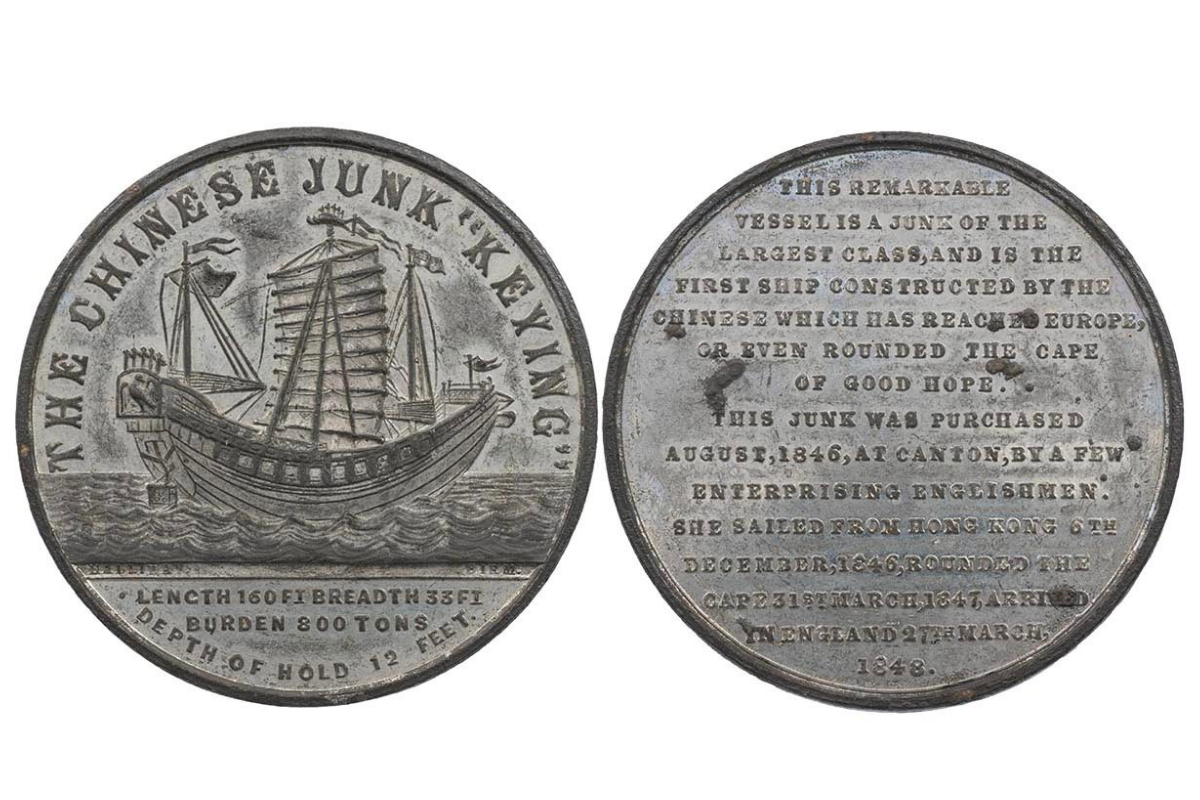
1848 The Chinese Junk Keying white metal medal by Thomas Halliday (BHM 2318), with some original lustre and small encrustations to the text side.
This white metal medal, part of our 18 February 2026 specialist sale, was issued to celebrate the arrival in London of the Keying: an 800-tonne three-masted Chinese trading junk, famous for its remarkable transoceanic voyage from China to the Western world between 1846 and 1848.
The First Chinese Ship To Visit London
Built in Fuzhou, the Keying was surreptitiously purchased in August 1846 by a group of British businessmen in Hong Kong, in defiance of Qing laws prohibiting the sale of Chinese vessels to foreigners. She was renamed after the Manchu statesman Qiying and immediately attracted attention in the Colony as the first Chinese junk to attempt a voyage to Britain. She departed Hong Kong in December 1846 under British command, crewed by a mixed complement of British officers and Chinese sailors.
In March 1847, the Keying rounded the Cape of Good Hope in severe weather, surviving a hurricane before continuing across the Atlantic. She arrived in New York in July 1847, becoming the first Chinese ship to dock there. The junk quickly became a public sensation. Moored off The Battery, she remained on display for several months, with tens of thousands of visitors paying 50 cents for the opportunity to board the vessel and view its elaborately decorated interior, which was furnished with 'Chinese curiosities'. Contemporary newspaper reports and promotional pamphlets emphasised the unfamiliar features of Chinese naval architecture, including the pronounced elevation of the bow and stern and the large painted eye on the prow. Later in 1847, the Keying sailed to Boston before departing for Britain in early 1848.
After a notably swift Atlantic crossing, the junk reached London in March 1848 and was brought up the Thames to the East India Docks. Once again opened to the public - this time at an admission fee of one shilling - it was widely advertised as 'the greatest novelty in Europe'. The Keying arrived in Britain in the aftermath of the First Opium War and at the height of Victorian fascination with China and the East, when demand for tea, silk, porcelain, and other Chinese goods was at its peak. Among the distinguished visitors who came aboard were Charles Dickens, Queen Victoria, Prince Albert and other members of the royal family.
Although it remained a popular attraction for several years, interest in the Keying eventually waned. The vessel was later towed to Liverpool, where it fell into disrepair and was ultimately dismantled.
The Chinese Junk Keying Medals
To mark the arrival of the Keying in Britain, approximately a dozen different souvenir medals were issued, all depicting the junk and bearing varying inscriptions recounting its historic voyage. This white-metal medal is among the most accomplished and visually appealing in the series.
The obverse shows a starboard view of the junk under sail on the main mast, with the legend 'THE CHINESE JUNK 'KEYING''' above. Below is a technical description of the vessel: 'LENGTH 160 FT. BREADTH 33 FT. / BURDEN 800 TONS / DEPTH OF HOLD 12 FEET.' below. The hold depth was actually 16 feet, and this detail is corrected on other Keying medals. Beneath the waterline appears the engraver's signature 'HALLIDAY.', with 'BIRM.' to the right.
The medal is attributed to Thomas Halliday (c.1780–c.1854), the leading Birmingham die sinker and medallist of his generation. However, Halliday's former apprentices, John Allen and Joseph Moore, who formed a partnership in 1844 as Allen & Moore, produced medals with closely related designs, suggesting a collaboration. Additional Keying medals are associated with Joseph Davis (1818–1857), another prominent Birmingham engraver of the period.
During the mid-nineteenth century, Birmingham was widely known as 'the workshop of the world' and the 'city of a thousand trades'. It played a central role in the Industrial Revolution, with Matthew Boulton's Soho Manufactory and Mint pioneering early forms of mass production and assembly-line manufacture. These industrial methods were first applied to small metal goods such as buttons, buckles, pen nibs, tokens, and medals, which were exported throughout the British Empire. The inclusion of 'BIRM.' on this medal is a signal of quality. While well-made, a medal made from white metal (a cheap tin or lead-based alternative to silver) would have been affordable to manufacture in large quantities.
The reverse features a long inscription that reads: 'THIS REMARKABLE / VESSEL IS A JUNK OF THE / LARGEST CLASS, AND IS THE / FIRST SHIP CONSTRUCTED BY THE / CHINESE WHICH HAS REACHED EUROPE, / OR EVEN ROUNDED THE CAPE / OF GOOD HOPE. / THIS JUNK WAS PURCHASED / AUGUST 1846, AT CANTON, BY A FEW / ENTERPRISING ENGLISHMEN. / SHE SAILED FROM HONG KONG 6TH / DECEMBER 1846 ROUNDED THE / CAPE 31ST MARCH 1847 ARRIVED / IN ENGLAND 27TH MARCH, / 1848’.
This pleasing example, retaining traces of original lustre, is a compelling relic of a unique moment in nineteenth-century maritime and cultural history. As both a souvenir of the Keying's sensational arrival in London and a product of Birmingham's thriving medal-making industry, it stands as a tangible relic of an unusual and revealing chapter in Sino-British relations.
Further Reading
Haddad, John Rogers. The Romance of China: Excursions to China in US Culture 1776-1876. Columbia University Press, 2008.
Wittman, Matthew. 'Chinese Junk Keying Medals'. Pocket Change Blog, American Numismatic Society. 8 April 2015. https://numismatics.org/pocketchange/chinese-junk-keying-medals/.