
Clipped Planchet Error D-Day 50p

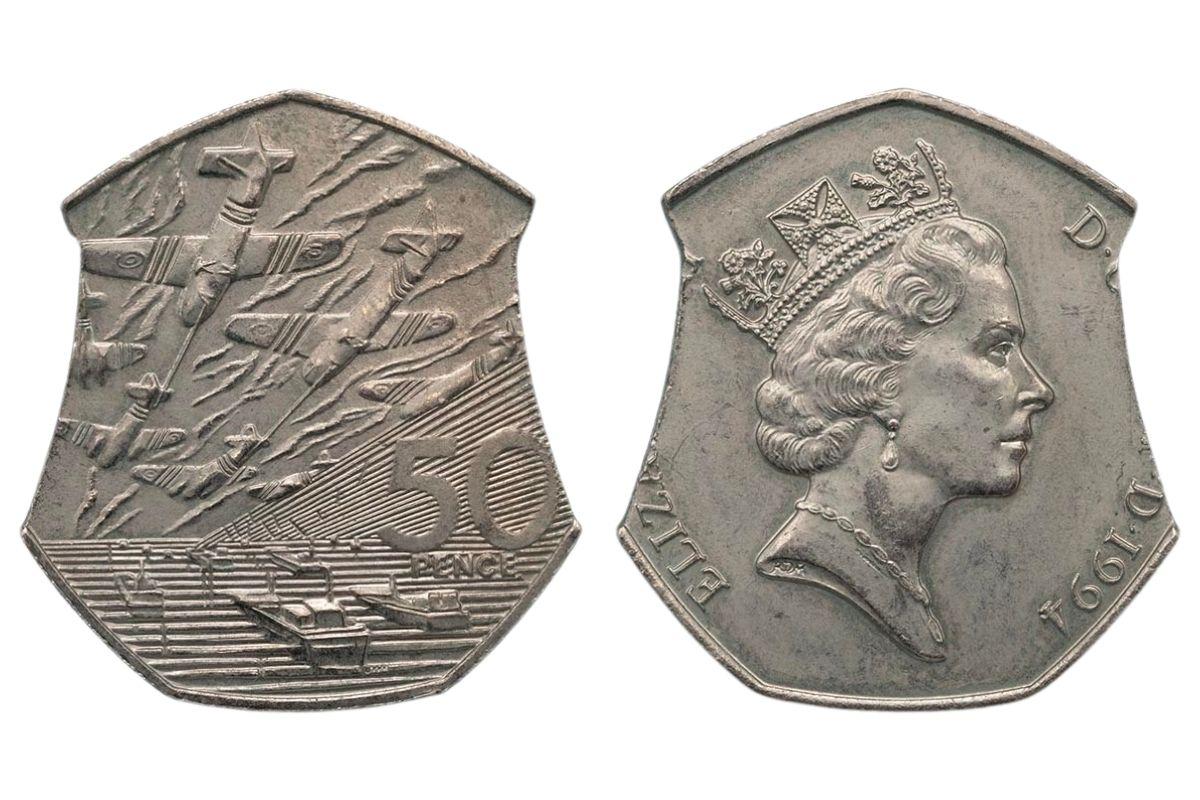

Clipped Planchet Error D-Day 50p
- Sale Date: 20th August 2025
- Estimated Price: 80.00
- Gavel Price: £0.00
Item Description
Clipped Planchet Error 50p - 1994 D-Day coin, struck for circulation with two large clipped areas, the shape of the edge of a Fifty Pence, preserving the majority of the design, including the portrait.
Have you ever seen a 50p like this?
This extraordinary error coin is going under the hammer in RWB Auctions' 20 August 2025 specialist sale, and it is sure to stop collectors in their tracks.
This 1994 D-Day 50p displays an exceptionally rare bowtie clipped planchet error, a type of minting mistake that dramatically alters a coin's shape and appearance.
The 1994 D-Day Fifty Pence
Issued to mark the 50th anniversary of the D-Day Landings, this 1994 Fifty Pence coin features a striking reverse design by artist and sculptor John Mills. The design depicts a flotilla of ships and planes moving across the English Channel, symbolising the Allied invasion of Normandy on 6 June 1944.
Unlike today's 50p coins, which were resized and reduced in weight in 1997, this 1994 cupronickel coin is larger and heavier, measuring 30mm in diameter.
Even in its standard form, the D-Day 50p is a favourite among change checkers for its historical significance and bold design. However, when combined with a genuine clipped planchet mint error, the coin's desirability and value are significantly enhanced. Errors like this are seldom seen on British coins, especially on commemorative designs.
What Is a Clipped Planchet Error?
Clipped planchet errors like this one occur at the earliest stage of the minting process, before the design is added.
All coins start as blank rounds of metal, referred to as planchets or blanks, which are punched out of strips of metal using a blanking press. If the strip is misaligned or if a punch overlaps an already cut section, a portion can be missing from the resulting blank.
High-tech minting machinery and modern quality control processes mean it's unusual for these faulty planchets to be struck with a design and very rare for the resulting coin to end up in general circulation, but some examples do fall through the cracks.
Collectors have identified several types of clipped planchet errors:
- Straight clip: a flat, straight-edged clip from the edge of the blank
- Curved clip: a smooth, rounded clip, often occurring along the outer edge
- Ragged clip: a jagged, uneven break, usually from the end of a metal strip
- Bowtie clip: Two opposing curved clips, giving the coin a bowtie-like appearance
Identifying Clipped Coins
It's important to differentiate genuine mint error clipped planchet coins from those that have been tampered with after they left the mint.
One of the key indicators of authenticity is the Blakesley Effect, a weakness in the rim directly opposite the clipped area, caused by the way metal flows during striking. Real clipped coins will also show metal flow distortion to the design in the areas immediately adjacent to the missing chunk. The edge itself may show two distinct textures, sometimes called 'cut and tear' marks, with half of the edge surface rougher and the other half smooth, an effect caused by the shearing action of the blanking press. Another obvious identifier of a genuine clipped error coin is that the missing area, when curved, has a shape similar to the edge of a non-error coin of the same denomination.
Bowtie Clip Error Coin
The D-Day 50p in our 20 August sale is an exceptional example of a rare bowtie clipped planchet error, with two large opposing curved clips that give the coin a dramatically altered silhouette. The clipped areas conform neatly to the unusual equilateral-curve heptagonal (seven-sided) shape of a standard Fifty Pence planchet, suggesting that the faulty planchet was cut from a section of metal that had already been punched.
Despite the dramatic error, the coin's design remains entirely legible. The reverse scene of D-Day ships and aircraft is undisturbed, and the obverse portrait of Queen Elizabeth II is unaffected by the clips: an unusual and aesthetically appealing outcome.
The combination of the pleasing placement, the commemorative design, and the rarity of the error type makes this coin particularly desirable.
Selling Clipped Error Coins
This coin joins a growing list of fascinating mint errors offered by RWB Auctions, including scarce mule coins, metal errors, and edge lettering anomalies. These coins frequently outperform expectations, with specialist collectors eager to secure examples that demonstrate clear and dramatic mint-made mistakes.
If you have a clipped planchet coin or another unusual currency item, now is an excellent time to consign it. With national publicity, strong specialist interest, and low vendor fees, RWB Auctions offers the ideal platform for bringing rare coins to market.
Contact the Coin Department at RWB Auctions today for a free valuation or to discuss including your item in a future specialist sale.
Further Reading
Diamond, Mike. 'Collectors' Clearinghouse: Errors & Varieties: Clip counts on incomplete planchet coins seldom exceed five'. Coin World. 17 January 2014. https://www.coinworld.com/news/us-coins/clip-counts-on-incomplete-planchet-coins-seld.html.
NGC. 'Curved Clipped Coins'. NGC. 1 October 2005. https://www.ngccoin.com/news/article/586/.
Sullivan, Jan. 'Collecting Clipped Planchet Error Coins'. PCGS. 11 April 2024. https://www.pcgs.com/news/collecting-clipped-planchet-error-coins.